







Categories
HMO Bridging Finance: A Guide to Investing in Houses of Multiple Occupation

For landlords looking to develop a valuable property portfolio with a strong return on investment, Houses of Multiple Occupation (HMOs) offer a unique opportunity.
With several tenants, an HMO property can offer additional stability and greater rental yield, but they also require specialist finance.
Mortgages are often too restrictive to support early-stage HMO investment, especially when renovation and conversion form a significant part of the project. Instead, bridging finance is used as a powerful first step.
This guide to HMO bridging finance explores the initial purchase and renovation stage of HMO investment funding, highlighting the powerful funding solution that gives landlords the capital needed to move quickly in a competitive arena.
Get a Bridging Loan Quote
Complete the simple form to receive tailored bridging finance options.
Loading form...

Table of Contents:
What Is HMO Bridging Finance?
HMO bridging finance is specialised funding for landlords to:
- Purchase an HMO property, typically at auction
- Convert an existing large residential property into an HMO
- Refurbish an HMO to meet regulatory standards and tenant expectations
It is effectively a short-term loan that has an exit-based structure, repaid as a single settlement rather than monthly repayments.
For HMO investment, the bridging finance is usually refinanced by a specialist HMO mortgage once works are complete and the property is generating rental income. This converts the short-term structure of the HMO bridge to an ongoing monthly payment.
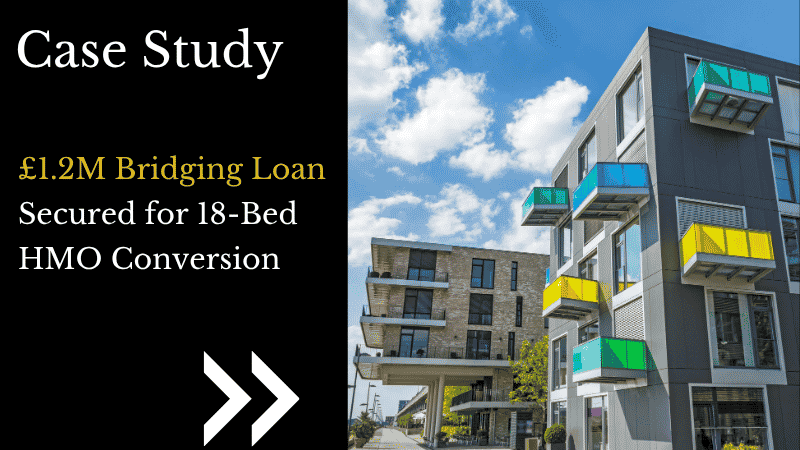
Alternatively, investors exploring a property conversion without the intent to continue with it as a rental property may sell the house to an HMO landlord, generating profit from the renovation process. This type of project uses an HMO bridging loan to execute a profitable house flipping opportunity.
HMO bridging finance can be arranged rapidly, helping investors buy or refurbish property quickly in a competitive market.
Unlike traditional mortgages, lenders focus on the property's value and future potential rather than current income, which helps speed decisions. Finance can also be secured on properties without working kitchens or bathrooms until renovations are complete.

What Is Classed as a House of Multiple Occupation?
To properly apply HMO bridging finance, it is important to clearly understand the legal implications surrounding HMOs.
An HMO is a property rented by:
- Three or more tenants: This refers to three or more unrelated adult individuals living in the property, typically in individual lockable bedrooms.
- Forming more than one household: Three tenants in a single household (for example, parents and an adult child) does not constitute an HMO. However, a couple forming one household, and a single adult forming a second household, sharing a two-bedroom property, would be an HMO.
- Sharing facilities (kitchen and bathroom): While individual bedrooms may have en-suite facilities, the occupiers still share facilities such as a kitchen and bathroom. Conversely, if each unit had its own cooking facility and en-suite, and there was no centrally shared kitchen, it would be a MUFB (Multi-Unit Freehold Block) and not an HMO.
Minimum room sizes also apply: 6.51m² for singles and 10.22m² for doubles. Larger rooms can help support stronger yields in HMO rental properties.
Most HMOs are typically student housing or professional house shares, or a combination of both. For investors, these arrangements typically provide the most profitable HMO rental yields.
Licensed vs. Non-Licensed HMOs
Landlords owning HMOs must often obtain a licence. This differs slightly between each UK country:
- In England, licensing is mandatory for large HMOs, defined as having 5 or more tenants
- In Scotland, licensing is required for 3 or more unrelated occupants
- In Wales, HMO definitions are broadly similar to England, though Rent Smart Wales governs licensing for all landlords in the country
- In Northern Ireland, HMO licensing is required for all HMOs
Additionally, local authorities are entitled to impose their own additional licensing requirements, with different regulations governing specific areas to allow councils to react to housing pressure and anti-social behaviour concerns in their regions.
It is important to identify all the relevant regulatory and licensing requirements prior to applying for HMO finance.
At Clifton Private Finance, we can help prepare your application, making sure you have everything in place before approaching a lender for a decision.
Planning Permission
In addition to licensing, HMO property developers should consider planning permission and possible restrictions.
In some councils, conversion from family homes (C3) to small HMOs (C4) may require planning permission, and more substantial structural changes may point investors toward a form of development finance rather than a simple bridge.
Check local planning rules and restrictions before purchasing your HMO property. While some lenders will offer HMO bridging finance secured on properties awaiting official planning permission, applications supported by clear project documentation and planning permission are more likely to receive approval.
Why Investors Use Bridging for HMO Finance
One of the key questions becomes: why use HMO bridging finance rather than an HMO mortgage?
The answer lies in the additional power and flexibility that bridging finance provides.
Under financial regulations, mortgages must meet several underwriting guidelines, whereas many bridging loans are unregulated and do not offer the same protections from the Financial Conduct Authority (FCA) as residential mortgages.
When exploring renovation and HMO conversion opportunities, mortgage regulations can result in limitations that create complications, including:
- Delays: Mortgages undergo complex valuations and underwriting processes, which means they can take many weeks, even months, to fully approve, while the more streamlined application process for bridging can provide access to funds far faster
- Rejection: Mortgages require the building to be in a habitable condition, meaning it must have a functioning kitchen and bathroom, and have no structural issues. Additionally, considerations such as damp proofing or fire exits can result in a rejected mortgage application. HMO bridging finance does not have the same restrictions and can fund properties without a working kitchen or bathroom
- Limited scope: Mortgages are designed primarily for building purchase. While it is possible to extend a mortgage size to encompass renovations, this is rarely as flexible as bridging. HMO bridging finance is specifically structured to provide funds for the conversion and refurbishment stages. This can include staged funding release to minimise interest in longer HMO conversion projects
Mortgage restrictions can quickly lead to investor frustration, potentially making the project seem impossible. An HMO bridging loan is typically a more suitable type of finance:
- Can be used for property in any condition
- Is fast enough to meet the demands of auction purchases
- Offers additional capital to fund conversion, renovation, and refurbishment
- Can help secure unusual properties, such as former commercial buildings or those needing structural refurbishment
- May provide funds in advance of licensing or planning considerations, to get the project started as soon as possible
- Can be staged to reduce the accumulation of interest
Due to the short-term nature of bridging, interest rates are usually higher than traditional mortgages, typically around 0.5% to 1.5% per month, and the loan terms are commonly 3 to 24 months, leaving less room for delays or planning hurdles.
HMO bridging loans do not replace mortgages, but are used alongside. The bridging finance funds the early stages, providing the capital needed to purchase the property and convert it for multiple occupation.
Once the house is brought up to the necessary habitable standard, an HMO mortgage is secured to pay off the bridging loan, and regular monthly repayments take over.
How to Successfully Secure HMO Bridging Finance
At Clifton Private Finance, we have the combination of industry expertise and lender relationships you need to get the HMO bridging loan you need to invest in a house of multiple occupation.
We’ll work on your behalf to compare bridging options, tailor finance to your exact circumstances, and negotiate with the lender to secure the most appropriate deal.
Get a Bridging Loan Quote
Complete the simple form to receive tailored bridging finance options.
Loading form...
Obtaining HMO bridging finance typically follows the following five steps.
1. Research and Budgeting
Successful conversion projects rely on solid planning and assessment. Before moving forward with your HMO conversion project, it’s essential to build comprehensive plans, including budgeting, financial planning, and an expected timescale.
For HMO property renovations, you should spend time properly evaluating:
- Property purchase price: Speak to estate agents and other experts in your area to evaluate the current market. For an auction, guide prices can sometimes be misleading, so research thoroughly to obtain a measure of realistic auction purchase prices
- Licensing and planning rules: Speak to your legal team and the property’s relevant local authority to understand any specific regulations that will influence your HMO conversion
- Conversion costs: Obtain quotes from architects and trusted contractors in the area. It’s important to understand how much you will need to budget for renovation costs within your project
- Fees and taxes: Stamp duty land tax (SDLT) and legal fees will need to be paid, with some costs requiring upfront capital that should be put aside
- Financing costs: Speak to a Clifton Private Finance expert early to help you factor in potential financing fees, arrangement fees, and interest costs. It’s worth a conversation at the preliminary stage to ensure those costs are properly accounted for
Weak budgeting can also strain cash flow if refurbishment costs rise. Thorough planning will help ensure your HMO project goes smoothly, minimising excess expenditure and increasing profits.
2. Conduct the Appropriate Property Valuations
Accurate property valuation is vital to determine your expected ROI and evaluate the project's viability.
It’s worthwhile to have a full independent survey done on the property before purchase, with traditional sellers, estate agents, and reputable auction houses all supportive regarding property surveys and valuation.
Research the expected final market price after your conversion is complete with similar diligence, creating realistic before and after figures that form the core of your financial plan.
An inaccurate valuation can reduce your loan-to-value and leave a funding gap, while lenders will also look at the gross development value to assess the project’s end position.
3. Secure the HMO Bridging Finance
With the clear plan developed, the next stage is to move to financing.
At Clifton Private Finance, as a specialist broker, we will support you throughout your application, whether you apply as an individual or through a limited company, helping with:
- Initial estimates and planning
- Comparing specialist lenders with flexible criteria, bridging loans, and HMO mortgages for accurate rates and terms
- Negotiating structures to match your specific requirements
- Determining a robust exit strategy
- Preparing your application for both an HMO bridging loan and a future HMO mortgage for exit refinancing, including ID, HMO property details, and financial records, as missing documents often delay the application process
- Managing the finance with staging where appropriate
Once initial financing is in place, you can purchase the property and begin the renovation works.
4. Purchase the Property and Manage the Conversion
The renovation stage is both the longest and most involved part of the whole HMO conversion project.
Careful management is required to remain on time and on budget, especially given the short repayment window of bridging and the need to keep work moving in a timely manner.
Delays or cost overruns can increase borrowing costs because of the short-term nature of the facility.
Agility and flexibility are essential to react effectively to any unplanned difficulties that occur.
5. Exit and Refinance with an HMO Mortgage
With the project complete, the property brought up to a modern habitable standard, and a new higher valuation for the house, the HMO bridging loan can be refinanced with a lower-cost, long-term funding, whether that is onto an HMO mortgage or a commercial term mortgage, depending on the case.
Clifton Private Finance has the experience to handle your HMO finance through to the final refinancing. Our bridging and mortgage teams will work together to hand over smoothly, ensuring unbroken support and guidance throughout the whole process.
With your bridging loan settled, finance becomes a traditional monthly mortgage payment, covered by the property’s rental income. Once refurbishment is complete and the HMO is generating rental income, refinance underwriting is different from the initial bridge, and lenders typically stress test rent at around 125% to 145% of mortgage costs.
Funding an HMO Conversion
Successful HMO conversions come from turning an existing building into a suitable modern environment that takes into consideration the unique requirements of multiple occupation.
Property refurbishment is typically required. This often includes:
- Reconfiguring layouts
- Adding en-suite bathrooms to each bedroom
- Considering fire safety pathways, interlinked smoke detectors, adequate escape routes, and replacing internal doors with fire doors
- Expanding the kitchen space to make it suitable for multiple occupants' use
- Developing shared living and work spaces
- Improving access and parking
- Considering accessibility needs
Shared amenity provision also matters, with enough kitchen and bathroom capacity for the number of occupants, typically around one sink and one bathroom per five tenants.
HMO bridging finance can cover these additional costs and help maintain cash flow during the works, making each a worthwhile investment that improves the market value of the property and the expected rental yield.
Delays and cost overruns are common in HMO conversion projects, so strong financial planning is important because extra time on site can increase bridging costs.
Done correctly, an HMO conversion can turn an opportune auction purchase into a strong investment for years to come.
Discuss your HMO conversion with a Clifton Private Finance specialist, who can help evaluate the exact needs and balance the costs of funding against expected returns.
With access to a wide range of HMO bridging finance lenders in the UK marketplace, we will match you to a lender who can best support your renovation plans.
The Exit Strategy for Your HMO Bridging Loan
A successful HMO bridging finance application relies on a credible exit strategy. At Clifton Private Finance, we understand how important this is and work from the outset with the exit strategy in mind.
Our mortgage team works hand-in-hand with our bridging experts throughout the process to ensure that exit finance is given the necessary focus.
While bridging finance is powerful, an HMO bridging loan is designed as a short-term solution to the challenges of HMO purchase and conversion.
The refinancing route should be modelled before drawdown using realistic rental income and post-works valuation assumptions.
- HMO landlords looking for a long-term investment with regular rental income will represent future funds through a pre-arranged HMO mortgage
- HMO investors planning on a house-flip renovation project will represent future funds through the property sale
The Clifton Private Finance bridging team will help you determine the exit strategy that best fits your plans and work with you to present this appropriately to the lender, with clear timelines, mortgage agreements in principle, and supporting documents.
If market conditions change or refinancing is declined, borrowers can come under pressure, which is why a clear exit strategy matters.
While it is possible to change the exit strategy partway through the project, this may incur additional fees as it substantially alters the nature of the lender’s risk assessment and underwriting.
A strong and well-defined exit strategy lowers lender risk:
- Improving your chances of a successful application, and
- Increasing the range of HMO bridging products on offer
Discuss exit strategies with your Clifton Private Finance adviser from the outset.
HMO Finance for Faster Completion Times
One of the key hurdles HMO property investors must overcome is swift action in a competitive marketplace. Often, ideal properties slip away because a cash buyer is able to move more quickly, seizing opportunities or gazumping deals thanks to their superior capital liquidity.
HMO bridging finance gives you that same power.
Since HMO bridging loans can be arranged within days, you can move in a timely manner to complete your purchase much faster than competitors who are reliant on traditional mortgages, especially at auction, where funds can often be secured in days rather than weeks or months.
In the UK, where limited space and a growing population make quality HMOs a strong investment, investors and landlords must move quickly to secure the best deals, often by working with specialist providers that can move faster than mainstream banks on time-sensitive cases.
If you’re looking at a town with a substantial student population, or an area popular with younger single professionals, you’ll need to move rapidly to secure those houses that offer the best rental yield.
Speak to us today to see how quickly an HMO bridging loan can be arranged.

HMO Finance for Greater Flexibility
When undertaking an HMO conversion, flexibility is essential.
Bridging loans can be tailored across your project to meet specific needs, including:
- Rolled-up, retained, or serviced interest: Interest is a key consideration for those using bridging finance. Our team will work with you and the lender to structure the interest to best meet your needs, including the option of serviced interest that can be paid regularly through the bridging finance term as monthly payments. Bridging loans also typically carry higher interest rates than standard mortgages, so you should check arrangement fees and any exit fees as part of the total borrowing cost.
- Staged drawdown facilities: Releasing the funds based on project milestones can further reduce interest, ensuring that money doesn’t sit idle in your account, generating unnecessary costs. Lenders do not always release all the money upfront, and projects with a clearly defined timeline benefit greatly from staged drawdown.
- Multiple properties as collateral: HMO bridging loans are often secured both on the main property and other existing properties. This lowers lender risk and improves effective loan-to-value (LTV), improving your borrowing potential and providing additional funds for larger refurb projects.
- Additional funds and rebridging: Should unexpected events mean more capital is required, your existing bridging facility can be renegotiated, leading to additional funds or a full refinancing that can extend timeframes and take into account new circumstances.
- Adjusted exit strategy: A clear exit strategy is essential, as changing market conditions, failed refinancing, construction delays, or cost overruns can create repayment difficulties and extra interest costs. If developments mean you need to change your exit strategy, either from an intended HMO mortgage refinancing to a final sale, or vice versa, we can negotiate a change in the planned exit. While this may incur additional costs with some lenders, it provides a key flexibility that understands real-world changes to long-term planning.
HMO Bridging Finance with Clifton Private Finance
Clifton Private Finance is here as your partner. With decades of experience in securing funding for HMO projects, from initial bridging finance, through conversion and refurbishment, to a long-term low-cost HMO mortgage, our team of experts can support you at every stage of the journey.
Our bridging specialists will help you secure the funding you need for your HMO project.
We offer:
- Access to the whole UK network of specialist HMO bridging lenders and specialist providers
- Decades of expertise in HMO bridging finance and smooth exit strategies
- HMO bridging loans up to 80% LTV
- Scalable funding is limited only by property value
- Loan values from £100,000 to £5m+
- Support from acquisition to refinance
- Rapid decision-making, with loans often approved within days
- Support across wider property finance needs, including HMO conversion finance for more complex projects
For stable HMO finance that’s tailored to suit your individual needs, speak to a Clifton Private Finance bridging adviser today.